Design of a chromatic dispersion compensation system for Optical Coherence Tomography (OCT)
Project description
Optical Coherence Tomography (OCT) is an imaging technique used to see up to a few centimeters inside human tissue. It requires two parts: the sample arm, and the reference arm. These two both give us a signal. The difference between those two signals is what we use to build the image. The issue with the technique is that the clarity of the image depends heavily on the depth of the sample. In order to have a clear image, the OCT system's reference arm must induce the same optical dispersion as the sample arm.
The goal of this project was the develop a variable-length reference arm that could be used with multiple sample arms using various techniques, such as a non-flat mirror.
This project was done as part of my first internship in 2015, under the supervision of Prof. Caroline Boudoux.
Results
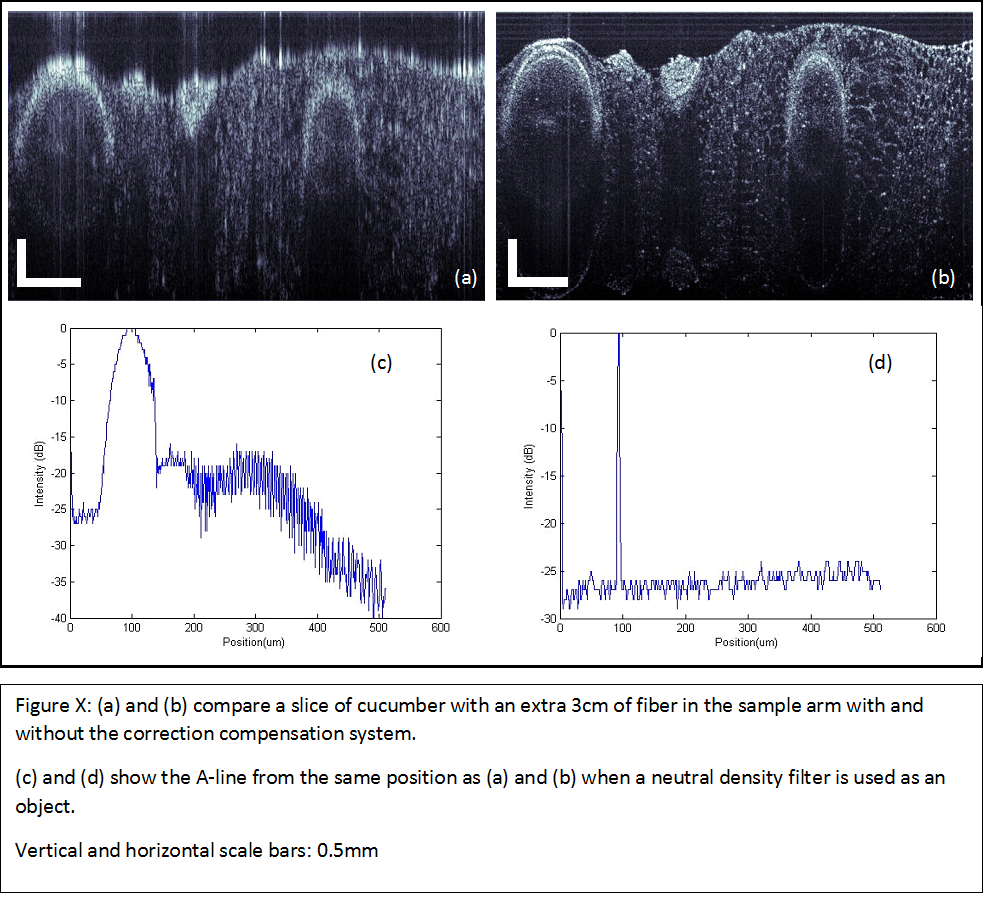
As we can see on the figure above in (a) and (b), our technique allowed to get a much clearer picture of a cucumber. Also, in (c) and (d), we can see that there is much less dispersion. The peak is our object, while everything else is pretty much noise. Our technique allowed to reduce this noise by a good margin.
Due to confidentiality issues, I am not allowed to give details on the technique used.